Friday, November 20, 2009

Christmas in November 2.

What do you do on a rainy November day in Napa? You go and do some early Christmas shopping, of course. There is a gift faire being held at the Napa Fairgrounds this weekend and although I don't normally have the inclination to attend such things, I kept a possible visit in the back of my mind as I thought my mother may enjoy it. I had to go over to Napa Fermentation Supplies to buy some drilled barrel bungs, and seeing as the faire was being held right next door, my mother and I did indeed decide to stop in and see what was for sale.
I really did not expect much, and to be quite honest there was a lot of dust-collecting nonsense being offered, but one particular stall caught my eye. Some enterprising young woman had come up with the idea of making jewellery, wind chimes, money-clips, candle holders etc. from old silverware. I had to take a second look because it was not immediately apparent that the goods she was tendering for sale were made out of old, unwanted silver utensils. Very clever indeed.
On a nice display rack, about 100 bracelets sparkled and beckoned to me to come and take a peek. My mother slyly asked me which one I liked and I immediately zeroed in on the only one that happened to have grapes on it, and which in a former life had been the handles of two old spoons . The bracelet is now mine. Thanks mum!

Saturday, November 14, 2009

The wild one.

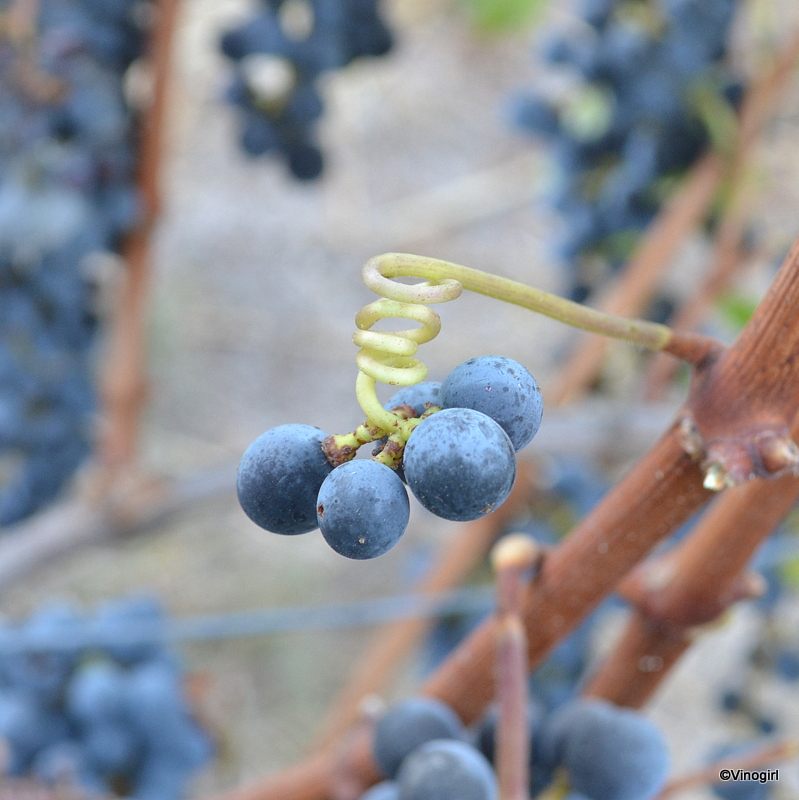
Autumn is indeed settling in and the few deciduous trees we have around Napa are showing off brilliant hues of yellow, orange, and red. One star performer in this category that often fails to get attention is Vitis californica, the native California wild grape. This deciduous vine is not shy and is very conspicuous, this time of year, in it's encroachment upon other vegetation. In riparian woodlands, stream-banks, and swales you can spot this wild vine scrambling up the trees and shrubs that are capable of supporting it's vertical growth habit of up to 40 feet. V. californica is important to wildlife as it's vegetation provides shelter and it's grapes, which ripen quite late, provide autumn and winter food for Napa's resident critters and our winter visitors.
The native vine has been employed in California since long before the first Spanish Padres planted their mission vineyards. Indigenous people cultivated and ate the grapes and leaves, used dried vines to weave baskets, and made tinctures to be used as mouthwashes and as a treatment for diarrhea. Lovely!
Apparently, jam can be also made from it's grapes. I have never personally seen a cluster of V. californica grapes. I've only glimpsed these vines from afar, usually out of my car window, and have never really felt a pressing need to clamber through a thicket, and risk getting a bad case of poison oak in the process, just for a quick look-see. There are plenty of cultivated grape varietals here in Vinoland to satiate any desire I may have to get up close and personal with a berry. Besides, who am I kidding, I much prefer having Thud and Prince Charles take care of all my jammy aspirations.

Thursday, November 12, 2009

One last hurrah!

With the first frost for Napa forecast for tomorrow, I decided to take one last pass through my vegetable patch. The tomato plants are still flowering so consequently they have fruit at every stage of development, partucularly the Roma tomatoes, so it looks like another pasta dish is on the menu for this week. The basil is still faring well, so a homemade tomato sauce is sounding better by the minute.
I managed to scavenge a small courgette that was obscured amongst a few zeppelins I had neglected to harvest in the past month or so. It was swiftly incorporated into a modified fried rice dish I have been making since I was a teenager. Paired with one of my favourite Napa Sauvignon blancs it was a fitting conclusion to the summer vegetable season.

Tuesday, November 10, 2009

Eye of toad.

With the recent end of Daylight Saving Time (a week behind the end of British Summer Time), it is now dark when I get home from the winery. Whether it is light or dark when I drive in through the gate, the Vinodogs are always barking and yipping in welcome, but more likely in anticipation of being fed. Tonight I was greeted by a plump, rather happy looking toad that sat in the middle of the path and was quite unperturbed when I bent down and got up close and personal with him. The western toad (Bufo boreas) was also quite happy to wait while I ran into the house and grabbed my camera for a photo op. The Vinodogs were sequestered on the deck so Mr. Toad was quite safe from becoming their dinner...but I did wonder what wine would pair well with Toad-in-the-Hole.

Sunday, November 8, 2009

Super fly.

The common fruit fly (Drosophila melanogaster), is running amock at the winery right now. With a rather large amount of Cabernet sauvignon fermentations all going at once, these annoying little diptera have come out of the woodwork, en masse. This is the same fly, with it's rather short, annoying little life-cycle that is used as a model organism in biology; including the study of genetics because it is easy to take care of, reproduces quickly, and lays tons of eggs. They are apparently very useful: Sister-in-law OTW assures me that they came in very handy when she was reading for her B.Sc at the University of Liverpool. That just may well be the case but I just can't handle them getting biblical on the rim of my glass when I am barrel sampling wine with some visiting dignitary.
Other than using DDT to rid yourself of these bothersome little devils, a relatively easy solution is to leave 'fruit fly traps' lying around, not foolproof but they help. Take a plastic drinking cup filled halfway with preferably still fermenting wine, cover the top with cling wrap, make an opening just big enough for them to crawl in and feed, but not large enough for them to get back out, and bingo! Darwin must have been on to something.

Saturday, November 7, 2009

A Guy's wine.

It's Saturday night and the task at hand for all in Vinoland is to drink some good wine and enjoy a slightly delayed celebration of Bonfire night.
We started the festivities quite early. Vinomaker, Thud and I quickly polished off a bottle of Laurent-Perrier Cuvée Rosé Brut before moving on to Vinomaker's finest '04 Cabernet franc, (a wine not suitable for women and children, except me of course.) But not before Thud had worked his magic with a can of treacle, butter, brown-sugar, water and lemon juice. This little tradition of whipping up a batch of homemade toffee for 'Bommy Night' is something Thud started when we were quite young children. The resulting treacle toffee was quickly dispatched whilst sitting around a fire pit, complete with a spark screen. Pathetic, I know, but this is tinder-box dry California after all.

Tuesday, November 3, 2009

Christmas in November?

I received my first Christmas gift today. I know, Halloween was a mere 3 days ago, Bonfire Night is still 2 days hence, and Thanksgiving (if you happen to be an English person who cares about that particular holiday), is yet more than 3 weeks away. But Christmas is looming large already; on telly commercials, in the shops and apparently, on the mind of my own personal Santa! An extremely generous co-worker left a rather large, gift-wrapped package for me at the winery, with the instruction to open it and enjoy it with my family before Christmas, if I wished. So open it I did, but only after I nearly threw my back out picking it up!
What was it? Oh, just a 6 litre bottle of 1998 La Vita Lucente. This Sangiovese/Merlot blend from Tuscany was the brainchild of Florence’s Lamberto Frescobaldi and Napa Valley’s Robert Mondavi when they united their efforts in 1995 to create a world class Italian wine.
I happen to love Italian wines, so this is going to be interesting...I just need to quickly organise a party to aid in the polishing off of what is the equivalent of eight bottles of wine. Any volunteers?

Saturday, October 31, 2009

Happy Halloween.

Nothing says Halloween in these parts like a spicy Napa Zinfandel, spicy Napa pumpkin seed brittle...and a few cheesy, little pumpkin decorations.
Happy Halloween.

Wednesday, October 28, 2009

It's raining Cabs.

Vinomaker has an abundance of Cabernet sauvignon fermentations right now, all bubbling away at once. Alongside our own clone 4 we have clones 2, 7, 24, 169 and 337, all intensely busy with their respective biological, chemical and physical approach to fermentation: Like some demented, oenological Fibonacci number sequence. I suspect Vinomaker must be following his own, hitherto unnamed, mathematical formula to keep track of everything that is going on. This includes yeast choice, as the selection of different strains of yeasts are a major contributor to the diversity of wine even among the same grape variety, never mind clonal variations.
Resembling one of Macbeth's demonic witches, Vinomaker is down in the winery twice a day working his magic. Performing punch-downs, taking temperatures, and spinning hydrometers in cylinders of adolescent wine; whilst all the time invoking the beneficence of Dionysus (or St. Vincent if I were the winemaker), in the successful transmutation of grapes into wine. There are handwritten notes, Excel spreadsheets, textbooks, website printouts, and industry catalogues strewn all over Vinoland. Where all of this wine is going to be aged, stored, and blended is still a mystery.
What is clear to me however, is that it is making it even more likely that the Vinodogs and I will have to look for an alternate living space...for a short spell.

Tuesday, October 27, 2009

The black grape of Avola.

Because Do Bianchi asked so nicely, I decided to say just a few words about the Sicilian wine I recently drank that had the Vino-seal closure. I usually try to steer clear of reviewing wine, but here goes.
Cusumano's 2007 Nero d'avola (the most widely planted of Sicily's indigenous red varietals), is a fruit driven, surprisingly high alcohol wine with a distinct Mediterranean character. Dark cherries and damsons abound, buoyed by a bright acidity. The pleasant spicy-plum finish is ample consolation for the fact that the wine is a tad unbalanced (due to the heat at the end.)
All in all, this offering of Nero d'avola was very entertaining because of it's unique closure, and was eminently quaffable because of the high standard of winemaking .
I hope the next bottle will be just as enjoyable. Never buy just one.

Monday, October 26, 2009

Vino-seal.

There is an ongoing, didactic discourse on certain wine blogs about which is the best closure for wine. It is an interesting topic, but sometimes the preachiness of it all gets a little tiresome. A screw cap can be a perfectly acceptable closure for a wine that you do not intend to age. Some proponents of the use of nothing but all natural cork are reaching ridiculous heights of brinkmanship, e.g. the folks at Celani Family Vineyards who feel the need to apprise the consumer of the exact size, to the closest millimetre, of the cork that bungs up their Cabernet sauvignon. I generally care more about what is in my glass, not how it manages to stay in the bottle.
One of the wines Vinomaker, I and everyone else drank after the christening, a week last Sunday, was a tasty offering from Sicily. It didn't really matter what the grape varietal was, we were all so enamoured with the Vino-seal closure that the contents of the bottle became secondary. Small things amuse...

Friday, October 23, 2009

Blue velvet.

Cabernet sauvignon grapes are amongst the most photogenic grapes around, their velvety blue hue is like no other varietal. Sure, Syrah, Merlot etc., are all black grape varietals but tend to look more purple on the vine whilst Cabernet sauvignon diplays the richest royal blue.
Here is my Clone 4 enjoying one last day idling in the California sun, for tomorrow is harvest day!

Sunday, October 18, 2009

One more for the team.

Today began with Vinomaker and me crushing and destemming some Cabernet sauvignon from a friend's vineyard; I did a little leaf-pulling in our vineyard, Vinomaker did some punch-downs on ongoing fermentations, and then it was time to get scrubbed up for our baby niece's baptism.
The St. Helena R.C. Church is a small, picturesque stone structure that just underwent six months of earthquake retrofitting...it's all better now and thus was the perfect setting for one of life's rites of passage...if you're Catholic.
It was a beautiful, joyous day filled with close family, well wishes, good food and of course, good wine...which was just as well, seeing as sacramental wine is no longer an option due to the threat of swine flu. I swear to God.

Friday, October 16, 2009

Gathering nuts.

Some enterprising Western Scrub Jay (Aphelocoma californica), has been busy squirrelling away nuts for the coming winter months in a tree up the road from Vinoland. I wish he'd gather more acorns for his larder from Vinoland as the walking-on-ball-bearing trick I have adopted to get to my car is an ankle-accident waiting to happen. Every 3 or 4 years we seem to get a bumper crop of acorns, 2009 is one of those years. The recent rain aided and abetted in the dumping of a massive amount of acorns onto the driveway. Of course, they drop at any old time but primarily when I am making a trip out to the dustbin...ouch!
Vinomaker is also busy stockpiling for winter, however his stash, ahem, is in liquid form! He has so many fermentations going on right now that the Vinodogs and I may have to move into a hotel, temporarily, to make way for all the fermentation bins.

Thursday, October 15, 2009

My girdle is killing me.

Whilst walking through the vineyard late this afternoon, checking on how the Syrah vines are shutting down for the winter, I noticed a red leaf. I did not panic, instead I checked the leaf's underside.
A ha! As I expected I found insect damage: girdling of the petiole. Now in this neck of the woods there are two main suspects for such crimes against vines; the Buffalo Treehopper (Stictocephala bisonia) and the Three-cornered Alfalfa Hopper (Spissistilus festinus). Damage to the vine occurs when continuous feeding punctures, resulting in the interruption of the movement of materials to the leaf, reduce chlorophyll production and cause anthocyanins to become the dominant pigment remaining in the leaf. The reddish leaves look like those of Leafroll virus, hence my concern upon espying the offending leaf.
It is obviously not a big problem, seeing as this is the only red leaf I have seen in the vineyard, but it was a momentary cause for concern. After all, you need healthy vines to make yummy wines.

Wednesday, October 14, 2009

Rain, rain, go away!

My poor grapes!
It rained all day yesterday. Let me qualify that...we just experienced, in the San Francisco Bay Area, the worst October storm since the 1960s. Vinoland looks like a battlefield. Mother Nature has deposited her detritus everywhere, the autumnal colours of which are pretty, but the acorns make walking around extremely difficult. Our creek is full, there are puddles everywhere, the firewood is wet, and the Vinodogs are bored.
Last Sunday I did a quick sugar reading of our Cabernet grapes. They were only up to a rather disappointing 22.8 degrees Brix, nowhere near ready to harvest...and now wet, grey weather.
My poor grapes!

Sunday, October 11, 2009

Frequent flyer miles?

Made in Argentina. Purchased in Liverpool. Consumed in Napa.
This has to be the most traveled bottle of wine I have ever had (next to the bottle of 1994 Opus One Thud purchased in Costco, Liverpool). And guess what?...it was delicious...even with jet-lag.
What a great combination; Pinot grigio and, one of Vinomaker's and my favourites, Torrontés. We frequently drink Susana Balbo's Torrontés but this blended offering from Familia Zuccardi is wonderful, combining the best characteristics of these two eminently quaffable varietals.
Thanks Monkey and Thud.

Wednesday, October 7, 2009

Breaking bread.

Last night a pleasant, balmy October evening was spent on the deck at Vinoland, with family, good friends, food and wine. As a thank you and goodbye to the Wisconsin Winos, and a welcome to family OTW, Vinomaker and I pulled some special bottles of wine from the cellar. Among them was this bottle of Mi Sueno Syrah, which seemed appropriate as the WW's had harvested our Syrah. Rolando Herrera's wine was delicious as usual...and a good time was had by all.

Sunday, October 4, 2009

Hello Syrah!

A busy day in Vinoland.
Vinomaker left at the crack of dawn to drive, once again, to Courtland to collect some Marsanne he had contracted to buy. I stayed in Vinoland and supervised our Syrah harvest. The Wisconsin Winos had arrived early, on this cool October morning, to assist with the day's activities. I stayed as long as I could and picked away with them but had to leave to collect Family OTW from San Francisco International.
Unfortunately, I didn't get to see the Marsanne and will have to be content with watching it ferment, but I will make sure I am around to drink the finished product.

Thursday, October 1, 2009

Many happy returns of the day V2!

Vinodog 2 (Canis-vino familiaris), is two years old today. Here she is reclining on the deck in the morning sunshine, in her party finery with a new, squeaky toy squirrel by her side.
It is with some astonishment that she is still here in Vinoland, after many threats to send her back to the pound for generally terrorising the vines, the neighbourhood, and last but not least, poor old V1.
The fact that she is so cute and constantly provides pure, unadulterated canine-comedy makes her a keeper.
Happy birthday V2.

Wednesday, September 30, 2009

Shedding some light on night harvesting.

Whilst walking the Vinodogs this evening after work, I noticed that the folks at Far Niente had decided to night harvest their Chardonnay vineyard that's closest to Vinoland. So, before I ran off to my evening class at NVC, I stopped to take a photograph of the preparations, portable lights in place and half ton picking bins just out of the shot.
Night harvesting can simply be a logistical issue, but mainly it ensures that the fruit arrives at the winery at the coolest possible temperature for processing, thus maintaining varietal characteristics and requiring less time and energy to chill the juice in the tank.
I love this time of year.

Sunday, September 27, 2009

Biological tinkering.

How did you spend your Sunday? Mine was spent chip-budding root stocks over to Cabernet sauvignon, Pinot gris and Syrah.
Unfortunately, there are unexpected casualties each year in a vineyard. Last year it was seemingly the mission of Vinodog 2 to prematurely dispatch a few plants to vine-heaven and it was primarily these that I was grafting today. However, there were also some gopher casualties and a couple of deaths from unknown causes.
The photograph on my post about chip-budding last year (Sept. 20th), showed the taped up graft. This year I decided to show the graft, sans grafting tape. You can see that the bud is a pretty close fit on the trunk of the rootstock. This is very important as the cambiums of the donor and host should match perfectly to ensure that the non-specific cells in the vines will ultimately become cambium cells, and that the trunk will accept the chip bud. I won't know if the grafts were successful until next April or so.
My knees ached a little bit from all the getting up and down, but all the aches were forgotten after a cold Sierra Nevada Torpedo Extra IPA. I fared better than poor Ron Combo, who from now on will be buying wine it seems, rather than helping with its production.

Saturday, September 26, 2009

What's Lincoln doing in the drink?

One of the main reasons for Vinomaker wanting to make Chenin blanc this year was a challenge from a fellow winemaker to participate in a 2009 'ferment-off'. This winemaker had given us a bottle of his 2008 Chenin blanc to drink and also the contact information for the grower. We chilled the wine down. It seemed nice at first, well balanced acid, nice fruity esters and then, as it warmed up, bam! Cabbage!
My tasting descriptors tend to be of the first thing that comes to my mind and this time, like one of the veggies in a good Sunday roast, cabbage it was. Vinomaker got more bad eggs than cabbage, so he initially identified the problem as H2S or more seriously, methyl mercaptan. H2S produces smelly, odoriferous sulphur compounds that may have developed in the wine because of poor fermentation practices. Time for the old copper penny routine.
A United States one cent piece, pre-1982, is 95% copper...drop one into a stinky wine and The Great Emancipator frees the bonds of sulphurous servitude and undesirable compounds. The metal in the coin reacts with the H2S in the wine, converting it into insoluble copper sulphide. It is rather rapid chemistry and what it usually means is that the previously stinky wine is now drinkable.
However, that was not the end of this little malodorous matter. The wine had actually moved beyond that and the problem was one of the compound methyl mercaptan...Vinomaker, where are you?

Friday, September 25, 2009

The caterpillar chooses the fairest leaves.

Speaking of photosynthesis...there won't be much of it happening in my vegetable patch if the attack of the killer Tobacco Hornworm, (Manduca sexta), isn't thwarted in some way.
I have had a spectacular crop of fruit this year from many different varieties of tomatoes including heirloom and plum tomatoes. This not so little hornworm has contrived to make my 'Early Girl' tomato vine it's home and dining room. The cheek of it!
I first became aware of it's presence when I spotted a bumper crop of caterpillar turds in my veggie patch, directly below where I spied it nonchalantly chomping away on the tomato plants foliage. Charming! Tobacco hornworm indeed, even it's name is disgusting.
The hornworm is now languishing in a large specimen jar (albeit with a supply of more tomato leaves for sustenance.) Let's see if it can chomp it's way out of that little pickle.

Sunday, September 20, 2009

Lovin' Spoonful.

C6H12O6 is the simple fructose molecule. Adenosine triphosphate (ATP), transports chemical energy derived from photosynthesis within the cells of grape leaves and converts it into sugar.
Today, we tested the sugar in our Syrah grapes for the first time this year. Using a hand-held optical instrument called a refractometer that measures the percentage of soluble solids in plant juice, we measured the grape sugar content in a random sample taken out in the vineyard. We got a reading of 21.8 degrees Brix. Brix is a scale that is used to measure the percentage of sugar in grape juice.
Many growers still rely on sugar readings to decide when their grapes are ripe. However, sugar readings are only one indicator of grape maturity. There are other qualitative and quantitative evaluations that can best predict the optimal time of harvest. Amongst these are; the softening of the berries, the detachment of skin from pulp, brown seeds and stems, the analysis of pH, and titratable acidity (TA)...oh, and taste. Under-ripe, herbaceous flavours are personae non grata in Vinoland, but a Brix reading of 24.5 or better is always welcome.
C6H12O6, the inclusion of which in grape juice makes a finished wine so appealing...and the exclusion of which in diet drinks makes Diet Coca-Cola so unappealing.